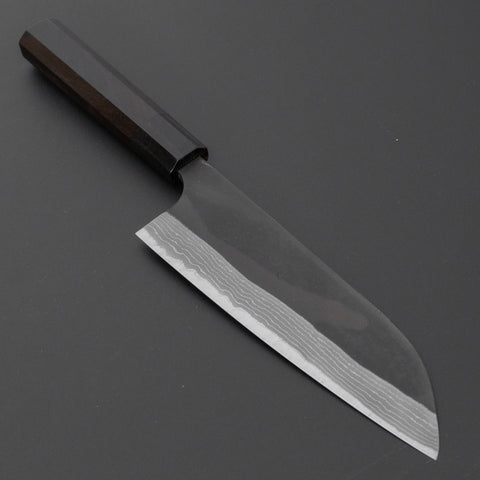
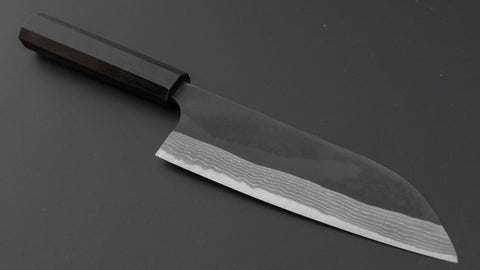
Kajibei Kurouchi Blue #2 Damascus Nakiri Ebony Handle
Producing Area: Sanjo-Niigata/ Japan
Product Type: Saya
Size: 230 x 63 x 11mm
Weight: 65g
Camellia oil (or tsubaki oil as it is also called) is used to protect your carbon knives from rust during storage. The oil is applied in a thin layer.
Hvorfor skal man betale for at få sin kniv slebet inden når man køber den? Ofte er knivene skarpe når vi modtager dem, men man kan virkelig løfte skarpheden til et andet niveau, hvis de lige får en tur på slibestenen inden de tages i brug.
Description
Description
Håndsmedet kniv fra Sanjo-Niigata med en simple, men virkelig smuk damacuscladding. Kniven er smidet i Aogami #2, så den kan slibes rigtig skarpt og holde skarpheden længe.
Brand: Kajibei
Smith: Kunio Ishikawa
Producing Area: Sanjo-Niigata/ Japan
Profile: Santoku
Steel Type: Carbon Steel
Steel: Yasuki Blue (Aogami) #2, Carbon Damascus Clad
Handle: Ebony & Buffalo Horn Ferrule Octagonal
Total Length: 311mm
Edge Length: 169mm
Handle to Tip Length: 183mm
Blade Height: 50mm
Thickness: 3.3mm
Handle Length: 128mm
Weight: 156g
Hand Orientation: Ambidextrous
What does Santoku mean
Santokuknife is ideal for a wide range of kitchen tasks. With its versatility and sharp edge, it is suitable for cutting, chopping and slicing various foods.
More about Carbon steel
Carbon steel is the classic Japanese knife steel. It can be hardened hard, can get a very sharp egg and is usually easy to grind up again. The most well-known types are Shirogami (white steel) and Aogami (blue steel).
Carbon steel contains little or no chromium, so it reacts with moisture and acid. The steel acquires a greyish to dark patina over time, and it can rust if it is left wet. Many of our carbon knives have a core of carbon steel in a sheath of stainless steel or soft iron. With a stainless shell, only the exposed core along the egg needs extra care. With an iron sheath, this applies to the entire blade.
Care & maintenance
Care & maintenance
Rinse and dry the knife thoroughly immediately after use, and never leave it in water. Never put it in the dishwasher. Wipe the blade when you are cutting, for example, citrus, tomato or onion. If the knife is to lie unused for a while, give the blade a thin layer of camellia oil. Patina is completely normal and not a defect. Use a wooden or plastic cutting board, not glass, stone or marble. Store the knife on a magnetic strip, in a knife block or in a saya so that the egg does not hit other things. Keep it sharp on a wet stone, and feel free to wipe it off on a leather strap in between.
Specifications
Detailed specifications
All measurements are taken on the actual blade — hand-forged knives vary slightly from piece to piece.


