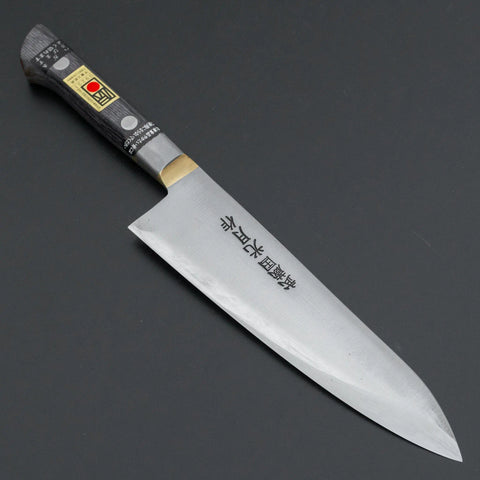
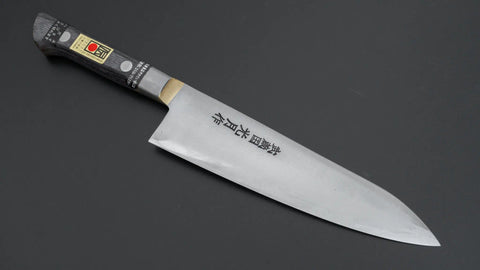
Kogetsu Carbon Gyuto
Hvorfor skal man betale for at få sin kniv slebet inden når man køber den? Ofte er knivene skarpe når vi modtager dem, men man kan virkelig løfte skarpheden til et andet niveau, hvis de lige får en tur på slibestenen inden de tages i brug.
Camellia oil (or tsubaki oil as it is also called) is used to protect your carbon knives from rust during storage. The oil is applied in a thin layer.
A leather strap is a good and gentle way to maintain the sharpness of your kitchen knives.
The knife is stroked against the leather 10-20 times, after which you have a super sharp knife again.
The leather is also used as the final deburring and polishing after Sharpening on wet stone.
The leather is mounted on a base, which can stand non-slip on the kitchen table.
Can be used with or without compound.
25.5 X 7.5 cm
Description
Description
Kogestu is a collaboration between father and son, who in their workshop Goko Hamono make the knives from scratch. The philosophy is functional perfection and each knife is carefully manufactured with that goal in mind. The result is unique knives with a rustic touch, all with individual characteristics. We don't get knives from Kogestu very often, so it's a good day in our little shop when we finally do.
The knife here is carbon steel with a western handle which also fits the larger hand.
What does Gyuto mean
With a slimmer profile and a sharper edge than many Western chef's knives, Gyuto is ideal for precision tasks such as cutting, chopping, slicing and filleting meat, fish and vegetables.
More about Carbon steel
Carbon steel is the classic Japanese knife steel. It can be hardened hard, can get a very sharp egg and is usually easy to grind up again. The most well-known types are Shirogami (white steel) and Aogami (blue steel).
Carbon steel contains little or no chromium, so it reacts with moisture and acid. The steel acquires a greyish to dark patina over time, and it can rust if it is left wet. Many of our carbon knives have a core of carbon steel in a sheath of stainless steel or soft iron. With a stainless shell, only the exposed core along the egg needs extra care. With an iron sheath, this applies to the entire blade.
Care & maintenance
Care & maintenance
Rinse and dry the knife thoroughly immediately after use, and never leave it in water. Never put it in the dishwasher. Wipe the blade when you are cutting, for example, citrus, tomato or onion. If the knife is to lie unused for a while, give the blade a thin layer of camellia oil. Patina is completely normal and not a defect. Use a wooden or plastic cutting board, not glass, stone or marble. Store the knife on a magnetic strip, in a knife block or in a saya so that the egg does not hit other things. Keep it sharp on a wet stone, and feel free to wipe it off on a leather strap in between.
Specifications
Detailed specifications
All measurements are taken on the actual blade — hand-forged knives vary slightly from piece to piece.


